Showing posts with label Pregnancy. Show all posts

Thursday

Birth Art


The seeds of global peace are planted in the hearts of family. Expansive love, balance and harmony in a household reflects out to the greater world and nudges the heartseeds of those who bear witness. May your family know and nurture peace.
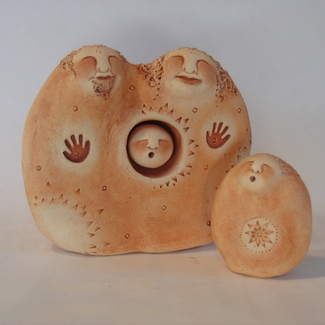
These are such lovely sculptures made by Bell Pine Farm in Oregon. They have a spiritual yet whimsical quality that make my heart smile.


Mandy-Saint Louis Doula

Monday

The Mama Bamba Way by Robyn Sheldon

The Mama Bamba Way
by Robyn Sheldon
[2008, South Africa, Sharp Sharp Media, 272 pages, paperback.]

[Review first published in Midwifery Today Issue 94, Summer 2010, © 2010, Midwifery Today, Inc. Review by Toni Rakestraw.]

The Mama Bamba Way shows a different approach to care during pregnancy. Along with the usual prenatal care, mothers in author Robyn Sheldon’s care also get instruction in chakra clearing, meditation sessions, guided imagery to meet their baby as well as many other empowering lessons.

How wonderful it would be if every pregnant woman could have the time to focus on her own inner journey during pregnancy. What a gift this would be to both mothers and babies. Sheldon discusses how birth choices of all kinds can impose limits on the birth. She suggests that sometimes, baby has a different plan that needs to be followed, and as parents it is up to us to go with the flow and let the experience be what it needs to be. Her writing style is easy to read and understand.

Sheldon stresses the importance of meditation. However, instead of directing mothers to “empty their minds” like many meditation instructions do, she suggests mothers focus on something such as the rhythm of breathing or the feeling of something on their skin. This technique helps mothers achieve the meditative state with ease.

The book discusses ways to prepare for the birth of your baby through the use of art, dreaming, meditative imagery, singing, toning and touch. All of Sheldon’s suggestions are very nurturing and gentle. Once labor begins, she shows parents how they can work together. She discusses signs of labor, induction, cord clamping and many other topics valuable to parents-to-be.

Sheldon gives some wonderful advice about kangaroo care, breastfeeding, touching for babies and other issues parents may find helpful postpartum when dealing with a new baby. She includes an entire chapter on grieving over the loss of a child, which is particularly difficult in our society. Mothers facing a loss are routinely told, “You’ll have another,” or, “It was for the best.” Sheldon shares another mother’s experience in tender words, letting us in on the secret that it is okay to grieve and to cry and feel utterly bereft. It is okay to feel inconsolable. If you know someone who has lost a baby, listen. Let them feel their grief. The words of wisdom shared in this chapter alone are worth the price of the book.

Reviewer Toni Rakestraw has birthed eight children, who have taught her the benefits of breastfeeding. She is a freelance writer and editor by day and is currently apprenticing at Midwifery Today magazine. Some of her recent artwork can be seen in the ICAN “Cesarean Voices” touring exhibit. Toni lives in Oregon with her husband and family.

Mandy-Saint Louis Doula

Sunday

Thinking Like an Herbalist

Thinking Like an Herbalist

To think like an herbalist one must come to know the ways that herbs interact with human physiology. Which herb will support the body’s healing process? Which herb is the best choice for nourishing the part of the body in need of healing? Which one relieves tension, thereby eliciting the relaxation response? How do the energetics of the herbs interact with the energetics of the human being?

To think like an herbalist, one must first consider the herbs that nourish the body and soul. Without proper nourishment, our bodies can’t work optimally.

“Nourishment encourages expansion and growth. Nourishment includes. Nourishment supports each being as a unique, holy individual. Nourishing our problems encourages love for all parts of ourselves.”(1)

Each herb has its own individual personality and each plant’s behavior, while in or on the human body, responds in specific ways.

Deciding which herb to use based on its actions, or properties, is a time-honored approach to herbalism. “Herbal actions describe the ways in which the remedy affects human physiology. Plants have a direct impact on physiological activity and by knowing what body process you want to help or heal, the appropriate action can be selected.”(2) After learning about the categories of herbal actions, one can then learn the subtle differences among the system affinities of various herbs.

As an herbalist, I am interested in the action of the herb, rather than the chemicals in the plant. The chemicals in plants work synergistically, not only within the plant, but also within the human body. For example, an herb that has astringent properties, such as plantain (Plantago major), yarrow (Achillea millefolium) or Shepherd’s Purse (Capsella bursa-pastoris), may assist in shrinking hemorrhoids.

The following is a list of herbal actions and the herbs in each category that I have used in my midwifery practice:

Alterative—Cleanse congested, stagnant blood and tissue fluids, gradually increase vitality through nourishment. Alfalfa, Burdock, Dandelion, Nettles, Red Clover, Yellow Dock
Anti-catarrhal—Mucus is the body’s way of protecting mucous membranes from foreign bodies. Anti-catarrhals thin mucus that has become so thick that it congests the membranes. Peppermint, Thyme, Yarrow
Anti-inflammatory—These herbs don’t take away the inflammatory response, but soothe and cool the inflammation, which in turn reduces pain. Calendula, Comfrey, Hawthorn, Marshmallow, Peppermint, Plantain, St. John’s Wort, Shepherd’s Purse, Yarrow
Anti-microbial—These herbs make the surrounding tissue uninviting to unwanted bacteria, viruses and parasites. They can also stimulate the immune response by activating lymphocytes. Calendula, Echinacea, Garlic, Peppermint, St. John’s Wort, Uva-ursi, Yarrow
Anti-spasmodic—These ease cramps in smooth or skeletal muscle and relax the autonomic and central nervous systems. Black Cohosh, Catnip, Motherwort, Peppermint, Red Clover, St. John’s Wort, Valerian
Astringent—Used to stop bleeding or to bind tissue, which then forms a protective coat. Comfrey leaf and root, Plantain, Shepherd’s Purse, Yarrow
Bitter—Herbs with a bitter taste stimulate and jump-start digestive juices. Dandelion, Yarrow
Carminative—They calm the lining of digestive tract and help to eliminate gas. Catnip, Motherwort, Peppermint, Valerian
Cholagogue—Stimulate flow of bile from the liver. Dandelion root, Yarrow
Demulcent—Soothe and protect irritated tissue in the digestive and respiratory tracts, aid in healing wounds. Comfrey leaf and root, Marshmallow leaf and root
Diuretic—Increase kidney output and rid the body of extra interstitial fluids. Burdock, Dandelion leaf, Yarrow
Diaphoretic—These are heating herbs that increase circulation and perspiration. Yarrow
Galactagogue—Stimulate breast milk production through nourishment. Alfalfa, Nettles, Raspberry leaf, Red Clover
Hepatic—Tone and nourish the liver. Burdock, Dandelion leaf and root
Hypotensives—Reduce systolic and blood diastolic pressures. Black Cohosh, Blue Cohosh, Garlic, Hawthorn, Motherwort, Nettles, Valerian, Yarrow
Nervines—May be tonic, relaxant or stimulant; many nervines are anti-spasmodic, as well. Black Cohosh, Catnip, Motherwort, St. John’s Wort, Peppermint, Valerian
Another time-honored approach for learning which herbs to use is searching through old literature that contains the wisdom of our ancestors. After all, can a plant that has been used for the same purpose for hundreds of years be dangerous or wrong?

References:

Weed, S. 1989. Wise Woman Herbal: Healing Wise. Woodstock, New York: Ash Tree Publishing.
Hoffman, D. 1992. Therapeutic Herbalism: A Correspondence Course in Phytotherapy. Forestville, California: California School of Herbal Studies.
— Janice Marsh-Prelesnik
Excerpted from "Thinking Like an Herbalist," Midwifery Today, Issue 87
View table of contents / Order the back issue

Mandy-Saint Louis Doula

Tuesday

Not Your Everyday Baby Shower

By Beth Osnes
Issue 138 - September/October 2007

We women have evolved a rather timid ceremony for preparing our fellow females for motherhood: the baby shower. The gifts provide some of the clothing and accessories a new mother is likely to need, but the shower usually shies away from the genuine majesty of this next step in a woman's life. With no malicious intent, most baby showers propagate a commercialism that belittles and "cute-sifies" the experience of motherhood and birth.

A true ceremony is a vessel for the swelling feelings that surround a life passage. It both contains and guides outpourings of emotion and, through its structure of ritual, ensures that our intentions arrive at the desired destination. Practically, a ceremony provides a beginning, substance, and an ending to a gathering of people who wish to honor an important occurrence in a life: an arrival or departure, a union, or an entering into life's next stage. Such transitions are not only witnessed by the surrounding community, but are supported both during the ritual and beyond.

You, brave mother, are just the gal to usher in a new tradition more nourishing to the soul than the traditional baby shower. But, like any expedition away from the status quo, it will take a bit of concerted effort, perhaps even some courage, to explore new and richer ground. If you think your family might write you off as a freak if you ask for a candlelit "wisdom blessing" instead of a baby shower with helium balloons, then begin slowly. There are degrees of transformation, so pace yourself.

Creating Ceremonies
When exploring new ceremonial ground, it helps to have a clear direction, both to guide the creation of the event and to ensure that you achieve your intention. It might be that you want your ceremony to nurture your mothering community, so that you can establish a council of women with whom you can share the challenges of raising your coming child. Do you want this ceremony to specifically welcome the new child? If this is your first child, do you want guidance for being a parent? If you're already a mother, do you want to be celebrated and nurtured for the greater strength you will need to care for another child? Do you want the blessings and prayers of your community?

A ceremony needn't be old to be meaningful, but it does need to be well-thought-out, and beautiful in some way. Simplicity, elegance, and clarity are good goals. A ceremony can braid together various traditions, but do try to keep one through-line that guides and shapes the gathering. For example, even if your event includes a Christian song, a symbol of Mother Earth, and a Rumi poem, it can still clearly focus on nurturing you as a new mother.

Getting Started
Talk with a good friend about the possibility of designing a birthing celebration that will incorporate your values, personality, and beliefs—the elements that stir you most deeply. With this friend, discuss these questions:

* What do I wish to accomplish with this ceremony?
* Around this goal, what images come most strongly to mind?
* How can this goal and these images be shared by a group of people?
* How might this goal be physically represented?
* How can we speak of it?

At this stage it's important that you be open to considering any idea—and take notes. This is the raw material you will use in the next step: designing your birth ceremony.

Designing Your Birth Ceremony
If you lead your guests into unfamiliar territory, they will want to feel that they are in good hands. Give them the security of a structure—one that makes sense and, through its design, conveys your purpose. Your design could be as simple as this three-part structure:

* The Beginning: a welcoming, to establish the purpose of the ceremony and briefly explain what it is and how it will be done.
* The Middle: the substance, to actually accomplish your goal for the ceremony (keep it simple and focused); this is the longest part.
* The End: an acknowledgment of what has just happened and what it means, a thanks to all involved, and a ceremonial sendoff (or a sending-over to the hors d'oeuvres and punch).

Read More.....


Mandy-Saint Louis Doula

BlessingWay

By Anne Nicholson Weber
Web Exclusive

When my friend Sandra was pregnant with her second child, she had a blessingway instead of a baby shower. Eight of her closest women friends came together one afternoon, each with an offering for a birth altar: a fan (to symbolize opening), a candle shaped like an egg to burn during labor, stones and feathers and talismans of all sorts. Each woman spoke in turn, placing her offering in the center of our circle and explaining its meaning. Some brought poems or other readings. We ate good food, and Sandra told us she felt strengthened to face the last endless weeks of pregnancy and the challenge of labor.

The blessingway is reputed to derive from a Navajo ceremony honoring the pregnant woman and preparing her for birth. My sister-in-law Julie, an anthropologist, says that while the Blessingway is an important aspect of the Navajo religion, it is not specific to pregnancy. But whether it has any true roots or is as artificially created as Kwanza, Sandra's birth blessingway convinced me that, like Kwanza, it meets profound needs.

And so, when I was eight months pregnant with my third, I asked my mother to host a blessingway for me. In addition to my contemporaries, we invited my two daughters (ages five and seven) and five women of my mother's generation whose mothering (now grandmothering) I have always admired. Having the elders there created the feeling of the women's lodge I sought, but their pre-feminist (indeed, pre-"women's lib") ideas of decorum ruled out the more adventurous rituals practiced in some women's circles, like foot washing and belly painting (which I think I might have liked). Although I didn't want an altar like Sandra's, I did want to create a talisman of some kind. In the end, I asked all the women who are dear to me--including those from out of town who could not attend--to send or bring not only a blessing but also a bead to be strung into a necklace for me to wear during labor.

The event began awkwardly. No one knew quite how to behave: Were we at a party or in church? Without the authority of tradition, we worried that what we were doing was silly or pretentious. But as we gathered in a circle and began to read the blessings aloud, the scene--bright afternoon and the wall-to-wall carpeting of my mother's high-rise apartment--seemed to thin, like a scrim curtain as the lights come up behind it, half revealing shadows of an ancient night, a firelit circle, women's mysteries.

The blessings were myriad: poems about pregnancy, birth, and motherhood, readings of all kinds, handwritten musings, and heartfelt good wishes. These built on one another, variations on a theme, a patchwork of woman-stuff about this most womanly of subjects.

The beads were myriad too. My five-year-old painted a wooden bead green and embellished it with gold dots. My sister-in-law Casey brought an ancient-looking turquoise scarab. My mother brought amber, which she knows I find magical. My friend Franny and her mother, Ruth, offered two pearl beads from a necklace that had belonged to Ruth's mother. Most amazingly, my sculptor friend created a "bead" of silver cast in the shape of a stylized womb!

And how could it be that my best high-school friend, now living in Washington, DC, and my husband's sister from Maine had chosen almost, but not quite, matching horn beads? How did my college roommate know that I would need a long oblong bead to match the amber from my mother? How was it that I received two jade animals, a fish and a bear? The symmetry seemed more than serendipitous. Strung together, these tokens of love--silver, glass, jade, and amber--became an object beautiful, weighty, and sacred.

I hung the necklace above our bed for the rest of my pregnancy and put it on when I was dilated to five centimeters. Within moments, hurricanes of birth power overtook my body, and our son appeared an almost miraculous twenty minutes later. My husband suggests that we should rent out my necklace as an alternative to pitocin.

I am neither religious nor superstitious, but this experience fed some primitive hunger in me. Our rituals can seem so empty, bloated by gift giving (in keeping with the materialism of our culture), but starved of the Jungian soup of dreams and myths that should nourish them. Although I relish an orgy of pink tissue paper as much as the next girl, cotton candy is no more food for the pregnant soul than for the pregnant body. The blessingway satisfied my craving for something much more sustaining.

And it's not just me. Casey is eight months pregnant. Last Sunday, blessings and beads in hand, we gathered for the blessingway she had requested.

Anne Nicholson Weber is a part-time attorney, writer, birth educator, and mother of three. She lives in Evanston, Illinois, and can be reached at anneweber@aol.com.

Mandy-Saint Louis Doula

Wednesday

A Note To Fathers: It’s You She Wants

A Note To Fathers: It’s You She Wants
by Lois Wilson

© 1999 Midwifery Today, Inc. All rights reserved.

[Editor's note: This article first appeared in Midwifery Today Issue 51, Autumn 1999.]

They are nineteen years old and in labor with their first child. Three months earlier they sat in my living room, asking questions and scribbling notes during childbirth classes. In many ways, they seemed to still be children themselves.

But not today. Today they are in labor. As each contraction begins to build, her small body loosens and lets go, her eyes close in concentration, her cheeks flush with effort. I sit and watch as he holds her, tears streaming down his face. Her pain is his pain. They are one in the process of birth.

Between contractions he wipes her face with a cool cloth, gently patting each eye with a tenderness that is like worship. As their labor unfolds I know that I am witnessing more than the birth of a baby. It is also the birth of a woman and a mother; the birth of a man and a father; the birth of a relationship that will never, ever be the same.

What is the role of the father who is present at the birth of his child? Is he a labor coach, advocate or partner? Is he a fifth wheel? A nuisance? A liability? In the twelve years that I have served birthing families in my community, I have heard many passionate opinions about the presence of fathers at birth. Over the years my own understanding of the role that fathers play in pregnancy and birth has developed to become much deeper and more complex as I have served different families, each with their own unique relationship, culture, expectations and beliefs.

In the early days of my work as a childbirth educator and doula, I saw fathers as "labor coaches" who had a unique place in the "birth team." Many of my couples gave birth in hospitals, so I prepared the fathers in my classes to assist their partners in two ways. First, as a labor assistant helping the mom achieve deep relaxation, working with her body and performing comfort measures such as massage. Some fathers loved doing these things. Others found them to be awkward and even embarrassing. With gentle guidance and encouragement, each father eventually found his own way of participating in his baby’s birth. But one thing was certain: each father was as unique as each laboring woman, and no predetermined agenda of mine was going to result in a cookie-cutter army of labor coaches able to do the job in the same way at each birth!

The second task I undertook was training fathers to be advocates for their partners in relationship to the hospital staff. This was accomplished by thoroughly explaining medical procedures, informing them of their rights, and reminding them continually that it was their baby, their birth, and their choice. Some dads really got off on this! The idea of storming the hospital and fighting for what they wanted was FUN. Often I felt as though I’d created a monster. I worked hard to teach tact, diplomacy and the fine art of negotiation. Other dads were absolutely terrified by the thought of doing battle with medical professionals. No matter how well prepared they were with information, no matter how empowered they were with choices, no matter how deeply they believed in their partner’s ability to give birth, they invariably ended up paralyzed and mute in the face of unwanted intervention—like deer caught in the headlights.

Once again it became clear that each situation, each couple, each birth presented unique challenges that simply could not be addressed in a predetermined, formulaic way. My approach to fathers at birth, I finally realized, would have to be like my approach to mothers at birth: guided by observation and intuition, deep caring, respect and a firm belief that if both he and his partner wanted him to be present and involved, then there was a unique niche for him and together we would find it.

Gone, now, were the labels and expectations. Instead, we looked for each father’s unique strengths and liabilities. Most of all, I assured each dad that he never had to be anyone or anything other than himself at the birth. I also told my dads that they were their partner’s lover and that their most important role at the birth was one they did every day without classes, books, or practice: loving the mom. You could literally see the dads relax as this thought sunk in and took root. Just be yourself. Just love your partner. It’s you she wants at the birth, not someone else’s idea of a labor coach. You.

And the result of all this was beautiful to behold: couple after couple finding the way to labor together in a dance that was uniquely their own.

Lois Wilson, CPM lives with her husband Tony and five children in Philadelphia, Pennsylvania, where she has a small and wonderfully diverse homebirth practice

Mandy-Saint Louis Doula

Saturday

The Questions Are More Important than the Answers

During the twentieth century, it had been commonplace to raise the main questions regarding childbirth in a negative way. How to give birth without pain? How to give birth without fear? How to be born without violence? As long as the questions are raised in this way, they will usually lead to sophisticated and sterile solutions.

Now the time has come to formulate questions in a positive way. The primary and paradoxically unusual question should be: What are the basic needs of women in labour? This leads one, via the physiological perspective, to take into account that labouring women must maintain a level of adrenaline as low as possible in order to give birth easily. One can conclude that one of the basic needs of labouring women is to feel secure.

Starting from the need to feel secure, one cannot help recalling the most common strategy women have used through the ages in order to meet their basic needs when giving birth. They have always had a tendency to give birth close to their mother, or close to somebody who could play the role of the mother—usually an experienced mother or grandmother in the community. This is the root of midwifery. A midwife is originally a mother figure. In an ideal world, mother is the prototype of the person with whom one feels secure, without feeling observed or judged. The need for midwives is better understood than 30 years ago, but the reason for midwifery needs to be rediscovered.

It is significant that, in his famous book Childbirth Without Fear, Grantly Dick-Read never made a distinction between a birth attended by a doctor and a birth attended by a midwife.

— Michel Odent
Excerpted from "Fear of Death during Labour," Midwifery Today, Issue 67
View table of contents / Order the back issue

Mandy-Saint Louis Doula